


2027 Suzuki Jimny review
The Jimny is more expensive than ever and remains an acquired taste, but there's an unexplainable charm that keeps us coming back.

CarExpert's verdict on the Jimny
Good
The Jimny's unmatched off-road ability keeps it clinging to a more positive rating than it'd otherwise deserve. While it's a fun and characterful small SUV, it's impossible to defend its astronomical price and poor road manners. The safety upgrades are welcome, though.
What we love
- Brilliant fun off-road
- Charming three-door vibe
- Expansive boot with second row stowed
Worth a thought
- Ridiculously expensive
- Still unfriendly on-road
- Weak engine/transmission combo
Are there other rating labels?
- Excellent
- An outstanding car in almost every way. A joy to drive, packed with great features, and highly recommended.
- Very Good
- A well-rounded car that's enjoyable to drive, offers great value or features, and is easy to recommend.
- Good
- A solid choice that does most things well. Comfortable, capable, and worth considering in this segment.
- Average
- Meets the standard for this segment. May not stand out, but still a dependable and reasonable option.
- Below Average
- Falls a bit behind others in the segment, but still passes safety checks and may suit specific needs or budgets.
Introduction
The evergreen Suzuki Jimny continues to sell up a storm, and it's finally received a fairly substantial update.
The fourth generation of Suzuki's iconic pint-size off-roader has been with us since 2019, and until 2026 it hadn't changed much. Of course, that hasn't deterred buyers, and the model that started life as a Japanese kei car has long been Suzuki Australia's top-selling model, and continues to rank among the nation's three most popular light SUVs – despite being the only compact SUV based on a rugged ladder frame.
But after a short time off-sale, the Jimny relaunched with some key upgrades. There were technology updates across the range, most notably the addition of a 7.0-inch touchscreen for the base Jimny Lite, and a 9.0-inch touchscreen for all others.
This brought wireless Apple CarPlay and Android Auto functionality, but also increased prices.
More importantly, the Jimny's safety tech offerings were modernised. The three-door lineup received front and rear parking sensors, lane departure prevention, adaptive cruise control, and updated autonomous emergency braking (AEB), the latter directly addressing the reasons for the original stop-sale.
Of course, the five-door XL already had some of this tech. Earlier this year, Suzuki Australia also bolstered the Jimny range with the addition of the limited-edition Rhino, and the re-introduction of the Heritage edition.
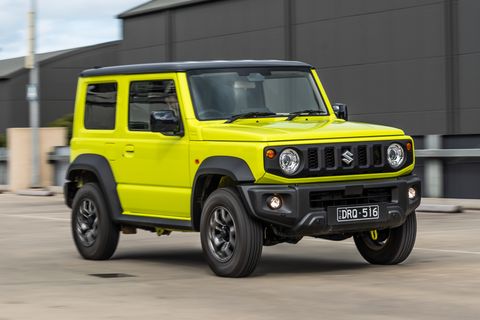
But the model you see here remains 'core' Jimny. It's simply the three-door 2027 Suzuki Jimny, fitted with a four-speed automatic transmission and finished in bold Kinetic Yellow paint.
There have been no powertrain changes, and it's still available with part-time four-wheel drive and low-range gearing as always.
So how is the little old Jimny getting on?
How much does the Suzuki Jimny cost?
Remember when you could pick up a current-generation Jimny for less than $30,000? That seems like forever ago, because the three-door auto on test here is priced at $36,490 before on-road costs – $10,500 more than when it was launched in 2019.
| Model | Price before on-road costs |
|---|---|
| 2027 Suzuki Jimny Lite manual | $31,990 |
| 2027 Suzuki Jimny manual | $33,990 |
| 2027 Suzuki Jimny XL manual | $34,990 |
| 2027 Suzuki Jimny auto | $36,490 |
| 2027 Suzuki Jimny XL auto | $37,490 |
| 2027 Suzuki Jimny Heritage auto | $42,490 – drive-away |
| 2027 Suzuki Jimny XL Rhino manual | $44,990 |
| 2027 Suzuki Jimny XL Rhino auto | $47,490 |
Unlike the more broadly appealing five-door Jimny, the three-door realistically sits in a class of one. If you wanted to consider some alternatives, they'd be off-road oriented light SUVs – but none of them will be as capable in the bush as the Jimny.
The most relevant is the Renault Duster, which costs $37,990 plus on-roads in flagship Techno 4×4 manual trim. Automatic versions exist, but they're front-drive-only in Australia.
Another option is the Subaru Crosstrek, exclusively available as an all-wheel drive model with an automatic transmission. It starts at $36,490 plus ORCs.
As for our tester, the bold Kinetic Yellow and black two-tone paint scheme commands an additional $1345, bringing its on-road price to over $40,000.
Compare the Suzuki Jimny
Want to see how the Suzuki Jimny lines up against the competition?
Use our comparison tool for a side-by-side look at the specs, features and prices of the Jimny and its rivals.

What is the Suzuki Jimny like on the inside?
When it arrived seven years ago, the latest Jimny's new but still relatively archaic cabin made some sense at its original price. Now? Not so much.
Of course, the Jimny has never been a luxury vehicle. Its cabin is hardly more than a metal box with just enough plastic and carpet to make it feel like a complete vehicle, rounded out with basic yet functional fittings that did only what you needed and nothing more.
But time has passed, and its price has inflated, yet the interior hasn't changed. That's no worry if you're buying one used, but Suzuki is really resting on its laurels in the new-car market.
It's hard to say what the Jimny needs to become more 'with it' – better tech, less plastic, lower prices, or all of the above – but it clearly needs something. As it stands, we can't really see where the money is going, other than into the pockets of the Japanese small-car brand.
Now, we know the Jimny has never had short model cycles. The third-gen model was on sale for 20 years, and its interior barely kept up with the times. But cars have progressed much faster during the lifetime of the latest model on test here, and that hasn't helped its perceived age.
On the plus side, the Mk4 Jimny's interior remains incredibly hardy. The lack of flashy appointments makes it feel far more robust than techier rivals, with strong grab handles and notchy switchgear that quickly quells any suspicions that this diminutive box on wheels is delicate. It's extremely utilitarian.
The hard, textured plastics should be very durable, and the exposed bolt heads clearly signal the car's rugged intent. Build quality also feels solid, with no undue rattles or creaks cropping up during our week-long loan.
Suzuki has also maintained a plethora of physical controls, with large switches and dials fitted for nearly every vehicle function. Again, these should hold up in the long run, and they're far easier to use than any screen-based systems.
The Jimny does have a touchscreen, albeit a very basic one. Unlike the 7.0-inch unit in the Jimny Lite, our tester features a 9.0-inch infotainment system that looks and feels like most other Suzuki systems: dated.
In here are only the most basic settings and info readouts, offset by the handy inclusion of wireless Apple CarPlay and Android Auto. The biggest advantage of this simple tech is that you don't have to rely on it to control the car, though we'd still want more for the price.
The only other screen in the Jimny is the LCD-style display in front of the steering wheel, primarily used for the trip computer. This is purely functional and suits the Jimny's vibe, as do the dual analogue gauges on either side.
Comfort-wise, the Jimny gets only the bare minimum. The seats are just soft enough not to give you a backache and are finished in unremarkable cloth upholstery, but naturally they lack power adjustment, lumbar adjustment, and heating. The thin steering wheel rim adds a bit of luxury with its leather wrap.
And, of course, it feels impossibly small inside. The front seats are close enough for occupants to rub shoulders, and storage space is limited: there are no bottle holders in the doors, no large trays for loose items, just a pair of cupholders in the middle, and a small passenger-side glovebox.
The rear of the three-door Jimny cabin is no more expansive. You have to choose between rear seats and cargo space, because you can't have both at the same time – not that we find that terribly surprising in a car like this.
Frankly, you'd only use rear seats (of which there are only two) if you were desperate, if you had a child, or if you were one. Second-row space comes at a premium, and the bench seat isn't all that comfortable, though Suzuki has still fitted child-seat anchor points for those so inclined.
If you choose cargo space instead, you'll be pleasantly surprised. Folding down the rear seatbacks creates a flat plastic cargo floor that almost makes it look like a commercial van back there, and the boxy body creates a huge amount of space for all sorts of cargo. It could use a few tie-down points, but there's a small lidded cubby for small items if needed.
The hard, open floor is ideal for muddy camping gear in particular, and those off-road adventures will be easier on the mind with Suzuki's standard inclusion of a full-size spare wheel on the side-hinged rear tailgate.
| Dimensions | Suzuki Jimny auto |
|---|---|
| Length | 3630mm – incl. spare wheel |
| Width | 1645mm |
| Height | 1720mm |
| Wheelbase | 2250mm |
| Cargo capacity | 85L (rear seats up) 830L (rear seats folded) |
To see how the Suzuki Jimny stacks up against the competition, check out our comparison tool
What's under the bonnet?
Powering the Jimny is still the same wheezy 1.5-litre naturally aspirated four-cylinder petrol engine, pumping out just 75kW of power and a meagre 130Nm of torque. Drive is sent to a part-time four-wheel drive system through a five-speed manual or, in the case of our tester, a four-speed automatic transmission.
| Specifications | Suzuki Jimny auto |
|---|---|
| Engine | 1.5L non-turbo 4cyl |
| Power | 75kW |
| Torque | 130Nm |
| Transmission | 4-speed auto |
| Drive type | Part-time four-wheel drive |
| Kerb weight | 1120kg |
| Fuel economy (claimed) | 6.9L/100km |
| Fuel economy (as tested) | 7.7L/100km |
| Fuel tank capacity | 40L |
| Fuel requirement | 91-octane regular unleaded |
| CO2 emissions | 158g/km |
| Emissions standard | Euro 5 |
| Braked tow capacity | 1300kg |
| Gross vehicle mass (GVM) | 1450kg |
| Payload | 330kg |
Our week with the three-door Jimny primarily involved commuting on higher-speed freeways and country roads, though we also dabbled in some off-roading.
The combination of high-RPM cruising and low-speed crawling contributed to our higher-than-claimed fuel consumption.
To see how the Suzuki Jimny stacks up against the competition, check out our comparison tool
How does the Suzuki Jimny drive?
Most vehicles can't have their driving experiences summed up in one word, but most vehicles aren't the Jimny. 'Agricultural' fits the bill here.
To expand, and clichés aside, there's no new model on sale right now quite as unique as the Jimny, at least not in the same way. It doesn't get more unfiltered than this.
Turning the key – there's no push-button here – fires up the modest 1.5-litre engine which settles into a fairly loud cold idle, and it's immediately clear there's not a whole lot separating that noise from the cabin.
That's really a theme with the Jimny, as it's unreasonable to expect much refinement. Our only major observation here is that the three-door is marginally less boomy inside than the five-door XL.
Plenty of road noise and driveline whine are immediately obvious, as is the lack of punch from the four-pot engine. The Jimny has never been a powerhouse, but it's always jarring to get back into one after driving literally anything else.
Stepping on the throttle rewards you with more engine noise, but not much oomph. This means you have to take extra care when pulling onto high-speed roads or going for an overtake; you don't have the luxury of instant torque for last-minute decisions.
The four-speed auto exacerbates that trait. It's a lazy transmission, and the lack of ratios requires it to kick down at even slight changes in throttle input or road gradient.
In fact, its behaviour is really quite comical. It becomes very easy to predict when the car will kick down and flare the engine speed towards 5000rpm, and you quickly learn that the Jimny is a rev-happy buzzbox.
It's therefore better suited to urban driving or off-roading, because those are lower-speed environments. On 110km/h freeways, the three-door Jimny is wobbly and loud, and cruises at an uncomfortably high 3500rpm – heaven forbid you hit heavy rain or a strong headwind. And gusty crosswinds make this slab-sided mini-SUV feel even less stable.
It's also a very interactive experience in urban settings. The steering is vague and super-slow, which means you'll be winding on the lock to throw the Jimny down side streets or through carparks.
That wobbly nature carries through to its behaviour over small imperfections, like speed bumps. The long suspension and solid front and rear axles give it a very stilted character, and it'll bobble about more than most conventional small SUVs.
Above all, though, the Jimny is a lot of fun. The gearbox's indecisiveness warrants you to thrash the gutless engine, and it responds very well to what we'd describe as slightly more 'chaotic' driving.
Even the body roll makes it feel lively and playful, and if the roads are wet, the skinny rear tyres can break traction if you're heavy-handed on the throttle while turning. As ever, the Jimny feels at its best when driven a bit more loosely.
And while that'll be an acquired taste on sealed surfaces, it's impossible to argue with the Jimny's off-road capability. It's always been a tale of two sides: horrible on-road, brilliant off-road.
Its generous ground clearance and sizeable approach and departure angles means you're less likely to damage the underside of the vehicle in deep ruts or over large logs on a firetrail, and the short wheelbase means you're unlikely to become beached on sharp crests, instilling plenty of confidence to head further off-road.
Of course, the shorter wheelbase means the three-door has a noticeably smaller footprint than the five-door, allowing it traverse bigger obstacles without dragging its undercarriage. But large bumps have a greater effect and it also feels a little less confident on steep hill climbs.
But that won't matter for the casual off-roader, because you still have a robust ladder frame and four-wheel drive system to fall back on. Keep in mind that you should only engage 4H on unsealed surfaces, but traction greatly improves as a result.
If the going gets really tough, it's easy enough to pop the Jimny into neutral and shift into low-range '4L' gearing. The additional low-range gear shifter has a super-chunky action, so it's very satisfying to interact with.
The only trouble you'll run into is if you're on offset moguls in low-grip conditions, because no Jimny comes standard with locking differentials. That said, a bit of momentum will keep you scampering up surprisingly steep and loose terrain, and the traction control is decent.
And the Jimny's narrow body also allows you to squeeze through tight areas a little more confidently, both off-road and on, as well as straddle deep ruts dug by larger 4×4s instead of scraping through them. It's back-to-basics fun.
The analogue experience is rounded out by the lack of intrusive safety gear. All the tech that it gained for 2026 – namely front and rear parking sensors, lane departure prevention, and adaptive cruise control – works without fault.
| Off-road dimensions | Suzuki Jimny auto |
|---|---|
| Track front and rear | 1395mm – front 1405mm – rear |
| Ground clearance | 210mm |
| Approach angle | 37.0º |
| Departure angle | 49.0º |
| Ramp breakover angle | 28.0º |
To see how the Suzuki Jimny stacks up against the competition, check out our comparison tool
What do you get?
The Suzuki Jimny is currently on sale in three grades.
2027 Suzuki Jimny Lite equipment highlights:
- 3-door body
- 15-inch steel wheels
- Full-size spare wheel
- Auto halogen headlights
- Front fog lights
- Power-adjustable side mirrors
- Plastic side mirror caps
- Black front grille
- Black door handles
- Cloth seat upholstery
- Digital information display incl. digital speedometer
- 7.0-inch touchscreen infotainment system
- Wireless Apple CarPlay and Android Auto
- DAB+ digital radio
- 1 x USB port
- 2-speaker sound system
Jimny adds:
- 15-inch alloy wheels
- Auto LED headlights
- Privacy glass
- Power-folding, heated side mirrors
- Black side mirror caps
- Body-colour door handles
- Leather-wrapped steering wheel
- 9.0-inch touchscreen infotainment system
Jimny XL adds:
- 5-door body
- Grey metallic front grille with chrome accents
- 4-speaker sound system
Jimny XL removes heated side mirrors and a digital speedometer.
To see how the Suzuki Jimny stacks up against the competition, check out our comparison tool
Is the Suzuki Jimny safe?
The Jimny’s three-star ANCAP safety rating from 2018 expired at the end of 2024, which means the current model is unrated.
Standard safety equipment highlights:
- 6 airbags, incl:
- Dual front
- Side
- Curtain
- Adaptive cruise control (manual and auto)
- Autonomous emergency braking
- Front and rear parking sensors
- Hill descent control
- Lane departure warning + prevention
- Reversing camera
- Traffic sign recognition
Jimny XL removes lane departure prevention, traffic sign recognition, and front parking sensors. Only the XL auto has adaptive cruise control.
To see how the Suzuki Jimny stacks up against the competition, check out our comparison tool
How much does the Suzuki Jimny cost to run?
Suzuki Australia backs its model lineup with a five-year, unlimited-kilometre warranty. Servicing for the Jimny is required every 12 months or 15,000km, whichever comes first.
| Servicing and Warranty | Suzuki Jimny |
|---|---|
| Warranty | 5 years, unlimited kilometres |
| Roadside assistance | 5 years (service-activated) |
| Service intervals | 12 months or 15,000km |
| Capped-price servicing | 5 years |
| Average annual service cost | $453 |
| Total capped-price service cost | $2265 |
Suzuki Australia’s individual service pricing is detailed below:
| Service | Price |
|---|---|
| 12 months, 15,000km | $449 |
| 24 months, 30,000km | $429 |
| 36 months, 45,000km | $589 |
| 48 months, 60,000km | $449 |
| 60 months, 75,000km | $349 |
As for rivals, Renault outlines five years of service pricing for the Duster, which totals $2475 for four-wheel drive variants. It's worth noting that the Duster's service intervals are also longer at 12 months or 30,000km.
Subaru, meanwhile, charges a total of $2444.04 for five years of Crosstrek maintenance. Its service intervals are the same as Suzuki's.
To see how the Suzuki Jimny stacks up against the competition, check out our comparison tool
CarExpert's Take on the Suzuki Jimny
It's still cute, and it's still lovable, but you really ought to know what you're in for if the Jimny is on your shopping list.
If you're mostly going to be driving on-road, the Jimny probably isn't for you. It's far less civilised than both the Duster and the Crosstrek, with few redeeming features in such settings – especially when you consider the price.
That said, and price aside, it's arguably better as a one-person commuter than the five-door XL, mostly because it's smaller and very city-friendly. It still isn't very economical, nor very pleasant if you regularly drive long distances.
If you're often out in the bush, the Jimny makes a lot of sense. It's very capable on the rough stuff, and has enough space for camping gear and other equipment. The breadth of aftermarket equipment options means the sky is the limit in terms of customisation, too.
All said, the Jimny remains a unique offering, and can be a lot of fun if you know how to make the most of it. If you want to capture the best of the Jimny's charm, you needn't look further than the fan-favourite three-door.
CarExpert can save you thousands on a new Suzuki Jimny. Click here to get a great deal.
Click the images for the full gallery







 Automotive Vehicle Spec Data & 4K images Powered by JATO Dynamics Ltd