


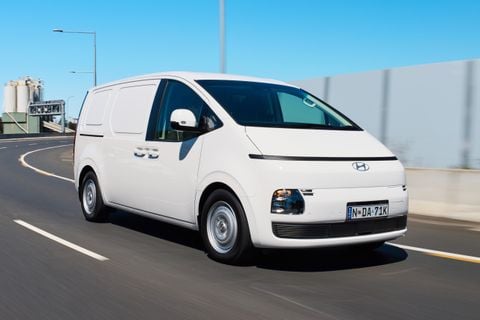
2027 Hyundai Staria Load Electric review: Quick drive
Hyundai has added an electric offering to its Staria Load lineup, but the electric commercial van is hiding some secrets underneath.

- Model tested
- 2027 Hyundai Staria Load
- Drive-away from
- $55,446†Better deals with CarExpert
CarExpert's take on the Staria Load
Very Good
What we love
- Cabin is absolutely spot-on
- Powertrain works perfectly for this application
- New rear suspension could be segment-leading
Worth a thought
- No hard partition behind front seats
- Blind spots can be frustrating
- Big upfront cost commitment over diesel
Are there other rating labels?
- Excellent
- An outstanding car in almost every way. A joy to drive, packed with great features, and highly recommended.
- Very Good
- A well-rounded car that's enjoyable to drive, offers great value or features, and is easy to recommend.
- Good
- A solid choice that does most things well. Comfortable, capable, and worth considering in this segment.
- Average
- Meets the standard for this segment. May not stand out, but still a dependable and reasonable option.
- Below Average
- Falls a bit behind others in the segment, but still passes safety checks and may suit specific needs or budgets.
Introduction
The term ‘quality of life’ will mean different things to different people. But ultimately, it’s about having options. And Hyundai just gave commercial van buyers another option.
The Staria Load range has expanded with a new electric version joining the diesel and hybrid variants for 2027.
When it comes to performance, the Staria Load Electric sits between the other two, with more power but less torque than the diesel, and less power but more torque than the hybrid.
However, in terms of pricing, the battery-powered Staria Load sits at the top of the lineup, being $21,000 pricier than the diesel and $17,500 more expensive than the hybrid. And while that may seem like a steep premium, for those using a van in a professional context – like tradies and ‘last-mile’ couriers – it can make a lot of sense.
For many, their days are made up of a lot of small trips – all conducted within a certain area – with perhaps a single journey to the depot or distribution centre to start or end their day.
Modelling submitted by the Trade Workers Union to the Fair Work Commission in March 2026 suggests that last-mile couriers – the people delivering your wine-induced Amazon packages at all hours – are covering approximately 125km each workday in these types of vans. So well within the 450km driving range of the Staria Load Electric.
Driving 28,000km annually, it would take an owner a little over three years to break even on the electric Staria Load – assuming they were recharging using free home solar power. Increase the annual distance to 50,000km, and they recoup the additional outlay in less than two years, compared to a diesel-powered Hyundai Staria Load (with urban fuel consumption of 8.9L/100km, and diesel costing an average of $2.624/L at the time of writing).
Before you come at me in the comments section, let me say that these are definitely best-case scenarios – like assuming free solar charging that’s already installed. But even for those paying 30c/kWh, they would break even after 4.3 years if driving 28,000km each year – dropping to 2.5 years based on 50,000km annually.
Frankly, that’s still a lot better than I was expecting. Even disregarding servicing costs, if an owner only keeps the van for the duration of the warranty period, that’s potentially tens of thousands of dollars not spent at the bowser.
But against the Staria Load Hybrid, it's a harder argument. At 28,000km annually, it would take 8.4 years to justify the extra spend on the Electric versus the Hybrid. That drops to around 4.8 years for a driver doing 50,000km every year, based on 30c/kWh charging.
So, for some people, in some circumstances, the numbers prove a use case. But the back-of-the-napkin maths only tells part of the story. What we want to know is whether the new electric van offers anything meaningful beyond fuel savings.
How much does the Hyundai Staria Load cost?
The Hyundai Staria Load lineup kicks off at $49,990 before on-road costs, which gets you the basic diesel variant, with the range-topping Staria Load Electric priced from $70,990 plus on-road – with a choice of either a conventional tailgate or 50:50 barn doors.
| Model | Price before on-road costs |
|---|---|
| 2027 Hyundai Staria Load | $49,990 |
| 2027 Hyundai Staria Load Hybrid | $53,490 |
| 2027 Hyundai Staria Load Hybrid Premium | $61,240 |
| 2027 Hyundai Staria Load Electric | $70,990 |
If you want to save on fuel, the Staria Load Hybrid is priced from $53,490 plus ORCs, with the Premium grade adding $7750.
For buyers not needing the same capability, the Kia PV5 is smaller, has a lower driving range, and a more daring design – but it's also cheaper, at $55,990 plus ORCs.
Other rivals include the Farizon SV, currently priced from $64,990 drive-away, which is longer and has a higher payload – but also has a lower driving range. Then there's the LDV eDeliver 7, which has the lowest driving range of them all, but can be purchased from $57,990 drive-away for those with an eligible ABN.
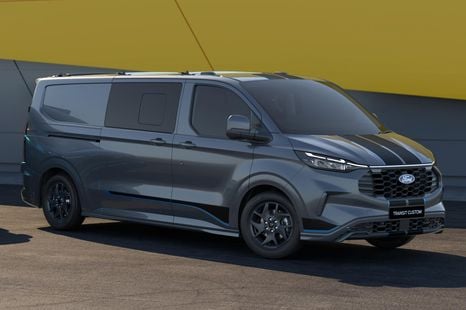
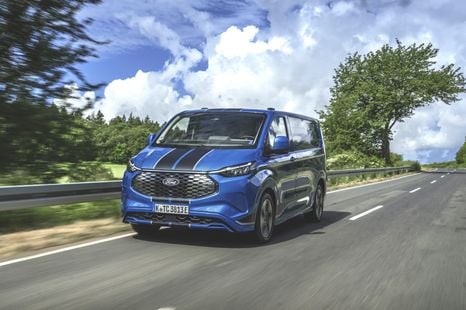
The Ford E-Transit Custom is more expensive, priced from $73,990 plus ORCs ($10k more than the Transit Custom PHEV).
Compare the Hyundai Staria Load
Want to see how the Hyundai Staria Load lines up against the competition?
Use our comparison tool for a side-by-side look at the specs, features and prices of the Staria Load and its rivals.

What is the Hyundai Staria Load like on the inside?
Thankfully, the Hyundai Staria Load Electric doesn’t stray far from its siblings, offering a modern yet intuitive cabin that feels like a pretty good place to spend some time.
Both the upholstery and plastics seem to be hardy and up to the job, but Hyundai has done a good job of making the interior feel welcoming and comfortable.
Like most models from the brand, the ergonomics are very good, allowing the driver to get comfortable from behind the leather-wrapped steering wheel. The Staria Load Electric also doesn’t feel like a bus, with more of an SUV-like seating position, and is easy to jump in and out of thanks to large door apertures and easy seat access – even if the seats are flat and lacking lateral support.
Despite the 12.3-inch digital instrument cluster and 12.3-inch infotainment touchscreen, the Staria still has a bunch of physical buttons and knobs to make life easier. What’s more, the switchgear is of excellent quality and enjoyable to use. It’s the little things.
In addition, Hyundai has kept the ‘standard’ layout of a right-hand indicator and light stalk, and a left-hand windscreen washer stalk. The electric van continues the use of the drive selector knob, located at the four o’clock position behind the steering wheel, and it works very well for jumping in and out of the vehicle.
The user interface of the infotainment system is also well designed and easy to navigate, and – perhaps helped by the near-silent electric powertrain – the Staria's sound system is actually quite impressive. Hyundai doesn’t market it as a premium audio system, but this isn’t a bottom-of-the-barrel two-speaker setup designed to save the company a few bucks – there’s clearly been some money and effort spent here.
Hyundai has also prioritised storage, with more cubbies and nooks than you know what to do with. Between the two front seats is a deep cargo box for carrying your lunchbox, and there are three cupholders accessible by the driver. There are also parcel shelves ahead of both front occupants, roof-mounted storage with elastic, and a wireless phone charger with a rubbery base to stop the phone from being flung about when driving.
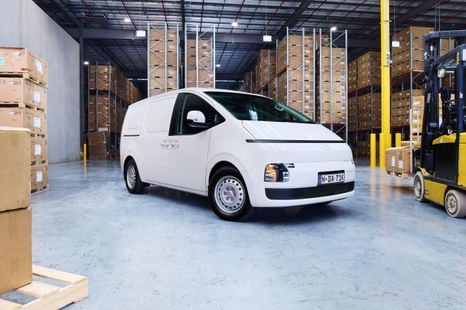
Out back, the Staria Load Electric is pretty typical of a commercial van. At no extra cost, buyers can choose between a standard lift tailgate – which is nice and light to shut – or barn doors for forklift loading. The floor comes with a vinyl covering and eight tie-down points, and there are sliding doors on either side, though windows can’t be optioned.
If you want even more storage, the lack of an engine means there’s a storage box up front. However, given the lack of bonnet struts, it’s more awkward to use.
All in all, the Staria Load Electric appears to really benefit from the fact that Hyundai sells a comfortable Staria people mover, in that the infotainment, switchgear, layout, and even the stereo are far nicer than would be expected for a light commercial van.
| Dimensions | Hyundai Staria Load |
|---|---|
| Length | 5253mm |
| Width | 1997mm (2269mm incl. mirrors) |
| Height | 2000mm (2026mm incl. antenna) |
| Wheelbase | 3273mm |
| Cargo bay volume | 4935L |
| Cargo bay length | 2607mm |
| Cargo bay width | 1640mm |
| Cargo bay height | 1436mm |
| Payload | 997kg – diesel 1039kg – hybrid 1005kg – electric |
To see how the Hyundai Staria Load lines up against the competition, check out our comparison tool
What's under the bonnet?
Pop the bonnet and you'll find a storage box that would probably work as a makeshift esky with a bag of ice. Underneath is a single electric motor sending 160kW and 350Nm to the front wheels, fed by an 84kWh battery.
| Specifications | Diesel | Hybrid | Electric |
|---|---|---|---|
| Drivetrain | 2.2L turbo-diesel four-cylinder | 1.6L turbo-petrol four-cylinder | Single electric motor |
| Total power | 130kW | 180kW | 160kW |
| Total torque | 430Nm | 304Nm | 350Nm |
| Battery | - | - | 84kWh |
| Transmission | 8-speed auto | 6-speed auto | Single-speed |
| Drive type | Front-wheel drive | Front-wheel drive | Front-wheel drive |
| Kerb weight | 2009-2063kg | 2040-2091kg | TBC |
| Fuel economy (claimed) | 7.0L/100km | 6.5L/100km | - |
| Energy consumption (claimed) | - | - | 20.7kWh/100km |
| Electric driving range (WLTP) | - | - | 450km |
| Max AC charge rate | - | - | 10.5kW |
| Max DC charge rate | - | - | 350kW |
| Fuel tank capacity | 75L | 65L | - |
| Fuel requirement | Diesel | 91-octane regular unleaded | - |
| Emissions standard | Euro 5 | Euro 5 | - |
| Braked towing capacity | 2500kg | 0kg | 2000kg |
Hyundai claims 450km of driving range based on the WLTP standard, and energy consumption of 20.7kWh/100km. We didn't have enough time with the Staria Load Electric to confirm the numbers, but like most EVs, this van does appear to make the most of heavy traffic and urban areas.
While the model can accept a DC fast-charge rate of up to 350kW – taking 20 minutes for a 10-80 per cent recharge – in the real world, it would take around 41 minutes for a 10-80 per cent recharge on a 100kW charger.
To see how the Hyundai Staria Load lines up against the competition, check out our comparison tool
How does the Hyundai Staria Load drive?
If you’re considering ditching diesel, then the Hyundai Staria Load Electric could well be the vehicle that tips the scales.
One of the biggest pluses for the electric Staria Load is the fact that it doesn’t feel like a significant departure from typical commercial vans – in the best way. There isn’t a giant learning curve to driving this thing, and the advantages far outweigh any of the negatives.
Pootling around tight loading docks and laneways of industrial areas isn’t intimidating in the Hyundai, thanks to its excellent turning circle and good throttle tuning. It has a turning circle of 11.96 metres, which isn’t quite as good as the Ford E-Transit Custom Sport SWB (10.9m), Kia PV5 Cargo S Long Range (11.0m), or Volkswagen ID. Buzz Cargo SWB (11.09m), but it’s better than the E-Transit Custom Trend LWB, LDV eDeliver 7, Farizon SV, and Peugeot E-Expert Pro Long.
Once away from the factories, we cut through some hilly residential areas, navigating street-parked cars and speed humps, with the strong flow of torque from the electric motor really benefiting this kind of driving.
But what goes up must come down, and the steep gradients meant the Staria Load Electric converted braking back into energy for the battery. In a diesel van, you’d eat more fuel due to the extra throttle load required to get you to the top of the hill, but that’s at least offset to some degree in this.
It’s worth mentioning that, despite Hyundai publishing an electric driving range of 450km (WLTP), our dashboard was claiming at least 100km more than that. And after about two hours of driving, we still had more than 520km showing, suggesting the numbers on the tin might be a little on the conservative side.
According to Hyundai, loading the Staria up to its maximum payload of one tonne only drops the driving range by around 50km, with aerodynamics supposedly mattering more than weight. We did have 375kg of weight strapped down in the back for our test, which no doubt helped skew the ride comfort to the positive.
But one of the most interesting things about the Staria Load Electric is the fact that it has multi-link suspension at the rear end, rather than leaf packs as on the diesel and hybrid. Hyundai was forced to redesign the rear suspension to accommodate the battery pack – which no doubt contributes to its higher price – and was able to maintain its one-tonne payload.
With the floor-mounted battery and the improved suspension, the result is a really composed and comfortable vehicle on the road, and one of the least compromised rides we’ve experienced in a light commercial van. Now, take that with a grain of salt, considering our 375kg pallet in the back, but in our experience the ride quality was nothing but good.
Handling is decent in the context of a commercial van, and we were still able to have a bit of fun on some twisty sections of the Ku-ring-gai Chase National Park, with the Nexen Roadian tyres offering okay levels of grip and feedback.
Hyundai said it prioritised road noise when choosing its rubber, due to the quietness of the electric powertrain.
Despite the big, uninsulated metal box out back and there being only a cage partition between the driver and the cargo area, extraneous sound is kept pretty well in check up until 110km/h – at which point the wind noise becomes more noticeable.
At lower speeds though, it’s a pretty quiet and relaxed environment – made even more enjoyable by the lack of a rattly turbo-diesel engine.
With a respectable 160kW on tap, it’s not the most powerful electric vehicle by any margin, but it’s the torque here that matters. It feels as if most of the 350Nm is available from the get-go and is well deployed, never really tapering off, and accessible at any speed. All of which means it gets up to speed effortlessly – even with some weight on board – and overtakes are a breeze.
While some EVs can have very jerky and unpleasant one-pedal driving modes – which maximise energy regeneration during throttle lift, allowing you to almost ignore the brake pedal in most driving scenarios – the Staria Load Electric is just about perfect in this regard, accessed easily using the paddles behind the steering wheel.
Adapt your driving to the one-pedal system, and you’ll be replacing your brake pads with the frequency of Halley’s Comet, and your brake discs once every millennium.
For some odd reason, the Staria Load Electric does have a button for different driving modes. But this is a light commercial van; there’s no need to complicate things. Standard mode offers a perfectly adequate balance between performance and economy.
We didn’t have any complaints with the Staria's advanced driver-assistance system (ADAS), which was relatively unobtrusive except for the speed warning system going off in school zones.
Really, our only problem was the blind spots. There’s quite a large area near where the A-pillar meets the dash that is hard to see past, and this van suffers from the usual van things including over-the-shoulder blind spots. Not being able to option glass in the sliding doors doesn’t help. Owners do get a blind-spot monitor – comprising little red warning lights in the mirrors – but the Staria would really benefit from the blind-spot cameras found in Hyundai's passenger vehicles.
Aside from those minor complaints, the Staria Load Electric really impressed. It drives beautifully on the road, with a composed ride, predictable handling, and decent performance all contributing to an enjoyable time.
To see how the Hyundai Staria Load lines up against the competition, check out our comparison tool
What do you get?
The Staria Load is reasonably well equipped for a light commercial vehicle – though if you're wanting a few more niceties, you'll need to go with the Staria Load Premium, which is only available with the hybrid powertrain.
2027 Staria Load standard equipment highlights:
- 2-seat configuration
- 17-inch steel wheels
- Automatic halogen headlights
- Liftback or Twin Swing doors
- Proximity entry and start
- 4.2-inch instrument cluster screen (diesel, Hybrid)
- 12.3-inch digital instrument cluster (Electric only)
- 12.3-inch touchscreen infotainment system
- Satellite navigation (Electric only)
- Over-the-air software updates
- Bluelink connected services – five-year complimentary, transferable subscription
- incl. remote control of climate and other vehicle functions, vehicle diagnostics and status info, live traffic and weather
- Single-zone automatic climate control (Hybrid and Electric only)
- Leather-wrapped steering wheel
- Cloth seat upholstery
- Electric park brake
Staria Load Hybrid Premium adds:
- 17-inch alloy wheels
- LED headlights
- Power tailgate
- Heated front seats
- Heated steering wheel
- Electrochromic rear-view mirror
- 12.3-inch digital instrument cluster
- Satellite navigation
Colours
Creamy White is the standard exterior paint colour for the Staria Load, with Shimmering Silver costing an additional $750.
For the Staria Load Premium, Abyss Black, Classy Blue, and Ecotronic Grey are available at an extra cost.
To see how the Hyundai Staria Load lines up against the competition, check out our comparison tool
Is the Hyundai Staria Load safe?
The Hyundai Staria Load is one of the few models to have two entries with the Australasian New Car Assessment Program (ANCAP).
ANCAP awarded the Staria Load a five-star safety rating in 2021 – expiring in December 2027 – however, this only applies to diesel and hybrid models.
Under its crash-avoidance test program, ANCAP gave the Staria Load a Platinum rating – with a 90 per cent performance score applying to hybrid, diesel, and electric variants. The Staria Load received 'good' assessments across all six categories.
Safety equipment highlights:
- Seven airbags: two frontal, two front side, one front centre and two B-pillar curtains
- Forward Collision-Avoidance Assist 1.5 (AEB)
- Rear blind-spot collision avoidance
- Rear cross-traffic collision avoidance
- Lane Keeping Assist
- Lane Following Assist 2; hands-on detection
- Driver Attention Warning
- Smart Cruise Control 2 with stop/go
- Intelligent Speed Limit Assist
- High Beam Assist
- Manual speed limiter
- Safe Exit Warning
- Reversing camera
- Front/rear parking sensors
- Individual tyre-pressure readout
- ABS, stability/traction control
- Hill-start assist
- Multi-collision braking
- Emergency-stop signal
- External pedestrian-warning sound
To see how the Hyundai Staria Load lines up against the competition, check out our comparison tool
How much does the Hyundai Staria Load cost to run?
The Hyundai Staria Load Electric is covered by a five-year, 160,000km warranty – with the battery getting a separate eight-year, 160,000km warranty.
| Servicing and Warranty | Hyundai Staria Load Electric |
|---|---|
| Warranty | 5 years / 160,000km 8 years / 160,000km (battery) |
| Roadside assistance | 24 months Additional 24 months (service activated) |
| Service intervals | 24 months / 30,000km |
Hyundai provides 24 months of roadside assistance, with an extra 24 months added each time the vehicle is serviced through the company's dealer network. The first two services are capped at $645 and $667 respectively.
To see how the Hyundai Staria Load lines up against the competition, check out our comparison tool
CarExpert's take on the Hyundai Staria Load Electric
I'd argue that ‘quality of life’ isn’t about owning exotic cars and watches, as lovely as they may be; it’s about having choices, so that you can find ways to reduce unpleasantness from your day-to-day. Sometimes big, sometimes small.
And if you need a van for work, the Hyundai Staria Load Electric is one big way of improving your quality of life.
Hyundai has been really smart with the electric Staria Load, as it doesn’t come across like it’s trying to be some kind of spaceship from the future. It feels more like a people mover with a big cargo space than a commercial vehicle, quite simply offering a lovely drive that never feels like a chore.
But it goes beyond that, because the interior is about as good as it gets, too. The Staria Load Electric strikes a perfect balance between subtle style and hardy utility, new technology and old-school switchgear.
Forget about the purchase of an electric vehicle being a political or environmental statement – this is a choice that can benefit your back pocket, while also making your work life a few degrees more enjoyable. It’s comfortable, (relatively) quiet, and means you won’t be smelling diesel on your hands every other day.
The quiet part really shouldn’t be underestimated. As someone who drove cars, vans, and trucks across the continent professionally for many years, it’s that constant, assaulting din that really contributes to fatigue at the end of a long day.
If you spend hours on the road each day for your job, consciously removing noise, vibration, and harshness from your life is a good thing.
On paper, Hyundai’s Staria Load Electric really doesn’t come across as anything special. But while its specifications look pretty standard, in the real world this vehicle is very good.
It’s a measured offering in all the right ways, giving owners more than simply ‘fit for purpose’. It’s a rare example of a vehicle that can genuinely improve your quality of life.
CarExpert can save you thousands on a new Hyundai Staria Load. Click here to get a great deal.
Click the images for the full gallery







 Automotive Vehicle Spec Data & 4K images Powered by JATO Dynamics Ltd