





2027 Audi Nuvolari review: Quick drive
Audi’s new supercar showcases a new design language and new intelligent quattro system that will appear in future mainstream Audis.
Introduction
The Audi Nuvolari is more than just a reborn R8.
Yes, it’s a mid-engined supercar like the R8, and like the R8 it shares hardware with a Lamborghini, in this case the raging, roaring Temerario. But the Nuvolari pushes the Audi brand into entirely new territory. It will be the fastest, most powerful Audi production car ever. And just 499 will be built, each carrying a price tag of more than $1 million.
Audi’s Formula 1 team plays in the same territory as Ferrari on the track. The Nuvolari aims to put Audi in Ferrari territory on the road, too. But the Nuvolari is no corporate ego-trip.
Audi chief technical officer Rouven Mohr calls the Nuvolari a design and technology lighthouse for Audi; a car that signposts not only a fresh new look for Audi’s future model lineup but also a new intelligent quattro system. “This is more than just a new model,” he says. “This is a statement of intent.”
The Nuvolari’s hybrid powertrain is identical to that of the Temerario. Its 4.0-litre, twin-turbo, flat-plane crank V8 is aided and abetted by three highly power-dense Yasa axial flow e-motors – two at the front axle, and one sandwiched between the internal combustion engine and the transversely mounted eight-speed dual-clutch transmission.
Total system output is 736kW. Intriguingly, that’s 60kW more than in the Temerario. The 588kW and 730Nm outputs of the combustion engine, which spins to an ungodly 10,000rpm, is the same. The extra grunt comes courtesy of the three e-motors, which each develop the same 110kW as in the Lamborghini, but are allowed to contribute more to the powertrain’s output under load.
The Nuvolari shares much of its aluminium space-frame structure with the Temerario, too. Large die-cast aluminium structural elements mean the Nuvolari’s chassis has fewer parts and is 24 per cent stiffer than that of the last-gen R8.
The increased stiffness means the Nuvolari boasts a more sophisticated suspension setup than the R8, featuring dampers whose four external valves enable more precise wheel and body control. The dampers also allow the Nuvolari to run 10 per cent softer springs, improving not just ride quality but also traction and grip, as they force the tyres to follow the contours of the road more precisely.
Carbon-ceramic brakes, with massive 430mm discs clamped by 10-piston calipers at the front axle, are standard. Unlike the carbon-ceramic discs on most other high-performance braking systems, however, those on the Nuvolari aren’t made using chopped carbon fibres. Instead, they use long fibres, a technique pioneered in F1.
Why? The long fibres have better thermal conductivity, enabling the Nuvolari’s rotors to shed excess heat 21 per cent faster than a conventional carbon-ceramic setup, ensuring more consistent pedal feel, even when you’re punishing the car hard on the track. And take it from us, the Nuvolari does go hard on the track.
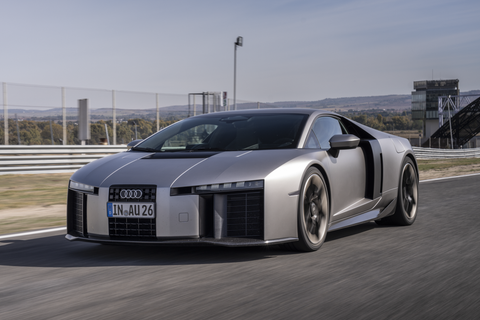
Audi laid on two cars for us to sample. Both were prototypes, and both were painted in slightly different shades of matte silver that made them look as if they were made of cast aluminum. Looks are deceiving, however: The Nuvolari’s body panels are constructed from hand-laid sheets of thin mesh carbon-fibre.
The thin mesh carbon-fibre means customers who choose to have their Nuvolaris with a visible carbon finish on the body panels will thus get something that looks as high-end as a Pagani. “It's very intensive regarding the production time because you have a lot of manual work,” says Mr Mohr of the Nuvolari’s bodywork, “but it's the only way to do it if you want to have the best surface quality.”
As you would expect of a supercar delivering 736kW, the Nuvolari is blisteringly quick. Audi says it will sprint from 0 to 100km/h in 2.4 seconds and hit 200km/h in 6.8 seconds en route to a top speed of more than 350km/h. It feels every bit that fast.
“Before you brake at the end of the straight, move a little to the right,” the Audi test driver in the RS e-tron GT told us before he led us out onto the undulating 3.85km, 16-corner Jarama Grand Prix Circuit just outside Madrid. “I must brake much earlier, and you will be doing 300km/h.”
He was right. The Nuvolari nudged 300km/h in sixth gear on each of our flying laps. And this was in Dynamic mode, not Race mode, as Audi wanted some stability control nannies looking after its precious prototypes.
With the e-motors ensuring there’s always plenty of torque and the V8’s ability to rev to 10,000rpm – its maximum power is developed between 9000 and 9750rpm – the powertrain’s bandwidth is extraordinary.
That said, you must learn to resist the temptation to upshift too early. Ride the torque when you need to but keep the tacho needle above 7000rpm and the Nuvolari feels explosively responsive, delivering thrilling acceleration that continues unabated all the way to the redline.
It feels nothing like any turbocharged car we’ve ever driven – apart from the Lamborghini Temerario, of course. Ironically, the V8 sounds better in the Audi than in the Lambo, with less clatter from the direct injection at low engine speeds. But it’s still not the most charismatic of engines; it shouts rather than sings.
What’s more impressive than the Nuvolari’s sheer speed, though, is its stability – under hard braking, as it dives into the apex of a corner, and under hard acceleration on corner exit.
Every time we grenaded the brake pedal at the end of Jarama’s main straight the Audi would squirm a little but never for a moment felt like it was going to spit sideways. Then, as we eased off the brake and pulled the steering wheel off-centre, the Nuvolari would obediently dive towards the apex of the corner, the front tyres resolute in their response and grip. And as we flowed it past the apex, we could then open the steering and go to power early and punch the car towards the next braking zone.
Through it all, the front-end felt rock-solid; utterly reliable and dependable. “The front axle is the master,” Mr Mohr said before we’d climbed behind the wheel. He was right.
That doesn’t mean the Nuvolari won’t get playful. The e-motor between the V8 and transmission is used to provide traction control, instantly switching to regen to slow axle rotation when it senses a wheel beginning to spin. And because it reacts so quickly, and with finer gradients of intervention than possible by simply clamping a brake rotor or cutting power, it never feels intrusive.
Be more authoritative with the throttle in Dynamic mode and the Nuvolari will oversteer, but the transition is smooth and predictable.
So, the Audi Nuvolari is exhilaratingly fast, both in a straight line and through corners, but it's also supremely confidence-inspiring. It's a car that allows you to explore the edge of the envelope without white knuckles, sweaty palms, and a knot in the pit of your stomach.
Crucially, you never feel it’s the car doing all the work. Rather, it’s as if the systems have helped you become part of the machine, enabling you to intuitively understand what the Nuvolari is doing right now, and what it’s going to do next.
It might have more power than its Lamborghini cousin, but that’s not why the Audi feels different to drive. The Nuvolari’s secret sauce is how its dynamic algorithms handle the data that streams from the small 6D sensor mounted close to its centre of gravity.
This sensor measures the six different ways in which the car’s body moves – three translational (longitudinal, lateral and vertical acceleration), and three rotational (roll, pitch, and rotation around the car’s longitudinal, transverse, and vertical axes, respectively) – and can thus show the car’s precise dynamic state at any given point in time.
That information is then fed into a software black box developed in-house at Audi called an estimator, along with data that shows steering, braking, and throttle inputs. The algorithms figure out what the driver is trying to do and then estimates the appropriate torque splits front to rear, and across the front axle, to help them do it.
We also got the chance to drive the Nuvolari on the road, which allowed us to try the Balanced mode (the normal key-on drive mode) and E-hybrid mode. Balanced mode delivers softer shifts from the dual-clutch transmission, while E-hybrid drives the car on the front e-motors as much as possible.
As the Nuvolari has a bigger battery than the Temerario – 7.3kWh versus 3.8kWh – it has a longer electric range, though Audi has yet to specify numbers.
The interior looks and feels minimalist and modernist, which is very on-brand for a car designed under the direction of new Audi design boss Massimo Frascella, who at JLR designed the current Range Rover and Defender. There are few physical switches and only a modest portrait-format central infotainment touchscreen.
But the well-shaped seats feel comfortable and the panoramic view through the windscreen makes the low and wide Audi easy to place on the road.
Audi is back in the supercar business. But the Nuvolari is a very different sort of supercar to the R8, and not just because of its power and price. It’s still very usable as a daily driver, but with heavier steering, a firmer low-speed ride, and minimal luggage space (though there’s a shelf behind the seats for bags and coats), it feels like a much harder-edged car.
Audi makes its money from premium hatchbacks, sedans and SUVs rather than supercars. Beyond grabbing headlines, what does the Nuvolari really mean for Audi, then?
Mr Mohr says an Audi should always be one of the most efficient models in its segment. Then he moves past the corporate boilerplate, the stuff that makes the accountants and legislators happy, and cuts to the chase: “An Audi should have character and emotion,” he says, “and it should drive very predictably, supporting the driver while delivering driving fun.”
That neatly sums up the Audi Nuvolari. Is it the future of Audi? We hope so.
Click the images for the full gallery







 Automotive Vehicle Spec Data & 4K images Powered by JATO Dynamics Ltd